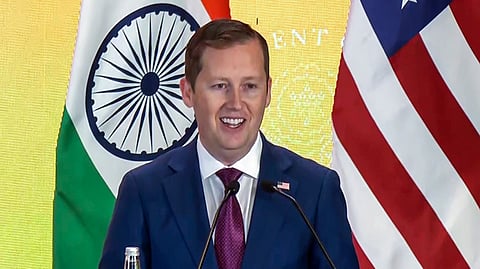

BENGALURU: US Ambassador to India Sergio Gor on Friday said the United States was committed to expanding its partnership with India, particularly Karnataka, citing the growing presence of American companies in the state and cooperation across artificial intelligence, data centres, pharmaceuticals, defence, energy and critical supply chains.
Speaking at the exclusive preview of the new exhibition 'Quantum' at Science Gallery Bengaluru, Gor said Karnataka had more than 1,000 American companies, with their presence growing steadily, and said US firms were increasingly looking at India for partnerships and investment.
"Ten years ago, our bilateral trade was USD 20 billion. Today it's over USD 240 billion. Those are real numbers," he said.
He said the US-India relationship was based on trust, pointing out that India conducted more military exercises with the US than with any other country and supplied 40 per cent of US generic pharmaceuticals.
He said one of his priorities after arriving in India had been to get India into Pax Silica, which he described as a trusted supply-chain initiative aimed at ensuring that critical supply chains were not disrupted.
Pax Silica is a US-led international initiative launched in December 2025 to secure global supply chains for artificial intelligence (AI), semiconductors, and critical minerals.
"You might have the best technology, but when you don't have magnets, or when you don't have critical minerals, it doesn't matter what you might have on the ground," he said, stressing the need for countries to work together on secure supply chains.
Gor said the US had invited India to be among the first 10 countries to join Pax Silica, followed by others including Germany and Japan.
He also highlighted the growing interest of American companies in India, saying he had met representatives of Meta, Rolls-Royce and Netflix in the 24 hours preceding the event.
Gor said the scale of US-India engagement was unmatched across sectors, with the two countries working together in areas ranging from AI and data centres to pharmaceuticals and defence sales.
"When you look around the world, there is no other country that you can name a sector and the United States and India are working together on it," he said.
He also pointed to rising cooperation in energy, saying US-India engagement in the sector had grown by 30 per cent over the previous year.
"The United States and India have limitless potential. That limitless potential goes through Karnataka," Gor said.
The Ambassador congratulated Science Gallery Bengaluru and the Karnataka government and said the US consulate in Chennai and the US Embassy in New Delhi were open to further engagement with the southern state.
"Whatever we can do to work together with you and take this relationship to the next level, you'll find an open and willing partner in us," he said.
Karnataka Chief Minister D K Shivakumar, said the state was committed to building a quantum technology ecosystem involving the government, universities, scientists, innovators, startups and established industries.
"Karnataka government is committed to extend beyond Bengaluru," Shivakumar said, referring to the state's plans to develop a Quantum City at Hesaraghatta with research-grade laboratory facilities.
He said Karnataka would work with the US on technology, innovation, research, defence and aerospace and sought a full-fledged US consulate in Bengaluru.
"We are asking for a full-fledged US consulate, not just a trade office," Shivakumar said, assuring that the state would provide suitable land and facilitate clearances.
Biocon Executive Chairperson and Science Gallery Bengaluru board chairperson Kiran Mazumdar-Shaw said quantum science was at a crucial turning point and would underpin the next generation of computing, sensing, secure communications and scientific discovery.
"Quantum science stands at a similar inflection point today.
What was once the preserve of physicists is fast becoming the foundation of the next generation of computing, sensing, secure communications, and discovery," she said.
She said the 'Quantum' exhibition aimed to make the emerging field accessible to the public and announced the proposed Public Lab Complex as the next milestone for the institution, bringing researchers, engineers, technologists and industry together for open and collaborative experimentation.
