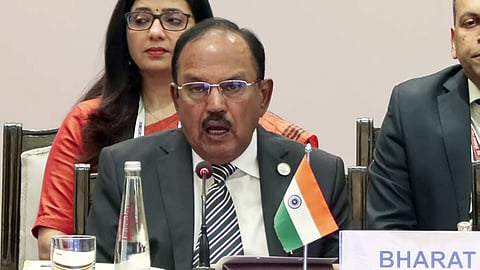

NEW DELHI: National Security Advisor Ajit Doval is set to travel to Beijing on Monday for the 25th round of talks between India and China's Special Representatives on the boundary issue.
The talks come ahead of Chinese President Xi Jinping’s expected visit to India for the BRICS summit in New Delhi. While there has been no official confirmation of Xi’s visit, officials remain hopeful that he will attend, potentially providing an opportunity for a meeting with Prime Minister Narendra Modi on the sidelines of the summit.
Doval, India’s Special Representative for the boundary negotiations, is scheduled to meet his Chinese counterpart, Politburo member and Foreign Minister Wang Yi, on Tuesday. Beyond the long-running border issue, the talks are expected to take stock of the broader bilateral relationship, the efforts by both sides to stabilise ties and the likely visit of Xi to India next month.
The timing is significant. Doval’s Beijing visit comes just weeks before India hosts the BRICS Summit in New Delhi on September 12 and 13. While Beijing and New Delhi have not officially confirmed Xi’s participation, officials are hopeful that the Chinese President will attend the meet which will provide an opportunity for a bilateral meeting with Prime Minister Narendra Modi, possibly on the day of Xi’s arrival for the BRICS summit itself.
Modi and Xi last met in August last year on the sidelines of the Shanghai Cooperation Organisation summit in Tianjin.
This would be Xi’s first trip to India in seven years and would carry considerable diplomatic weight following years of strained ties after the 2020 military confrontation in eastern Ladakh and amidst efforts to normalise and stabilise the relationship between the two neighbours.
The Special Representatives’ mechanism was established in 2003 to pursue a political framework for resolving the boundary dispute along the approximately 3,488-km India-China border. Twenty-five rounds of talks have yet to produce a final settlement, but the mechanism remains an important channel for managing one of the most sensitive aspects of the relationship.
The discussions are particularly relevant as both countries seek to consolidate the easing of tensions along the Line of Actual Control and restore broader engagement. Progress on the border, however, remains central to any sustained improvement in ties.
Doval’s meetings with Wang will help advance dialogue on the unresolved boundary question and create the political space for a broader reset ahead of the BRICS summit and the crucial meeting between President Xi and Prime Minister Modi. Both countries have set in motion a series of measures to rebuild trust which includes improving connectivity, people to people ties and other measures.

Ahead of the Doval-Wang talks, External Affairs Minister S Jaishankar on Saturday stressed that peace along the border is essential for improving bilateral ties with China.
"I think we went through a particularly bad patch between the summer of 2020 and the autumn of 2024, and that was primarily an outcome of the situation in the border areas," Jaishankar said at the Economic Times World Leaders Forum in New Delhi.
"At the end of the day, peace and tranquillity in the border areas is a prerequisite for good relations, and the state of the border, to a very large measure, naturally would determine the state of the relations," he said.
His remarks came amid reports of increased Chinese military activity in Arunachal Pradesh’s Upper Subansiri region in recent weeks.
China’s Foreign Ministry spokesman Guo Jiakun said on August 12 that the situation along the China-India border was "generally stable at the moment”.
Referring to the 36th meeting of the Working Mechanism for Consultation and Coordination on China-India Border Affairs, Guo said, “The two sides agreed to maintain communication via diplomatic and military channels and jointly uphold peace and tranquility in the border areas”.
External Affairs Ministry spokesperson Randhir Jaiswal said on August 11 that India considers developments in the border areas with China "most serious" and that maintaining peace and tranquillity along the Line of Actual Control is of "utmost importance".
New Delhi has also rejected Beijing’s objections to India’s decision to formally identify 27 places and geographical features in Arunachal Pradesh by their standard names, reiterating that the State is an "inalienable and integral" part of India.
China, which claims Arunachal Pradesh as part of South Tibet, has been issuing its own names for places in the region since 2017. India has dismissed the move as "vain and preposterous", maintaining that such actions cannot alter the "undeniable" reality that Arunachal Pradesh "was, is, and will" always remain an integral part of India.
(With inputs from PTI)