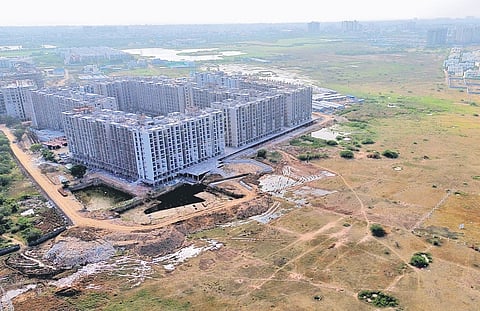

CHENNAI: The one-kilometre restriction on construction around the Pallikaranai marshland will continue, with the Madras High Court on Wednesday directing the litigants challenging the blanket freeze on development permissions to approach the Supreme Court. The order leaves builders, residents and landowners without immediate relief, as the Chennai Metropolitan Development Authority (CMDA) has confirmed that it will not process fresh planning applications within the restricted zone in the Ramsar site.
“Only projects that have already received approvals can continue. Fresh proposals cannot be processed,” CMDA member-secretary A R Rahul Nadh told TNIE.
The HC bench of Chief Justice Sushrut Arvind Dharmadhikari and Justice G Arul Murugan passed the ruling while disposing of a batch of 13 petitions challenging the National Green Tribunal’s (NGT) September 24, 2025, order imposing the restriction. The petitions were filed by CREDAI Chennai, real estate developers, residents’ associations, trusts, and individual landowners.
CREDAI Chennai president Mehul H Doshi told TNIE the association was shocked by the outcome and would approach the SC immediately. “After hearing the matter for so long and getting a revised interim Zone of Influence prepared by the Tamil Nadu State Wetland Authority, asking the petitioners to go to the SC does not seem right,” Doshi said.
The dispute centres on the NGT’s direction to the CMDA not to grant planning permissions within the Pallikaranai Ramsar site and its one-kilometre Zone of Influence until an Integrated Management Plan is finalised. The CMDA subsequently issued an order on October 9, 2025, freezing planning approvals and building permits across the marked area.
During the HC proceedings, the State Wetland Authority submitted a revised proposal based on a scientific assessment by the National Centre for Sustainable Coastal Management. The proposal reduced the interim Zone of Influence from 3,474 hectares, or 8,584 acres, to 36 specific survey numbers covering 128.19 hectares. These were identified as areas directly affecting water inflow and drainage connectivity. The authority also proposed permitting regulated construction subject to environmental safeguards.
“The entire development is frozen in that area. It is not only new projects; even ongoing projects are facing problems because banks are not releasing funds,” Doshi said.
Going by the state’s submissions, the one-kilometre zone covers parts of 15 villages and 84.2% of the area was already densely built up before Pallikaranai received Ramsar recognition in 2022.
Why did HC refuse to interfere?
1. The High Court said the identification, demarcation and ground-truthing of wetland boundaries, including Pallikaranai, were already under consideration before the Supreme Court.
2. Since the Zone of Influence is measured from the notified wetland boundary under the Wetlands (Conservation and Management) Rules, 2017, the HC said the core boundary had to be verified and finalised before any interim buffer could be altered.
3. When the SC is actively monitoring, a High Court must refrain from passing parallel or conflicting orders altering its protective perimeter.
4. The court also noted that the TNSWA’s revised proposal dated October 1, 2026, was only tentative and stated that the final Zone of Influence could be notified only after the ground-truthing exercise was completed.
