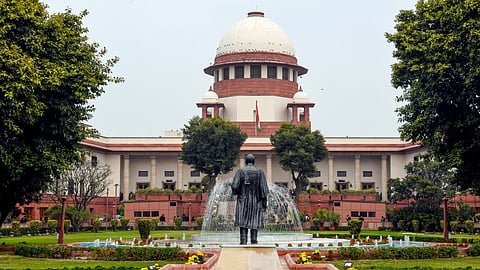

The Supreme Court of India on Tuesday allowed the Chief Justice of the Calcutta High Court to deploy civil judges and seek judicial officers from neighbouring Jharkhand and Odisha to handle nearly 80 lakh claims and objections arising from the Special Intensive Revision (SIR) of electoral rolls in West Bengal.
A bench comprising Chief Justice Surya Kant and Justices Joymalya Bagchi and Vipul M. Pancholi took note of a letter from the Calcutta High Court Chief Justice stating that 250 district judges currently assigned to the SIR exercise would need around 80 days to process the claims and objections.
The bench permitted the deployment of civil judges to speed up the process. It also asked the Calcutta High Court Chief Justice to approach his counterparts in Jharkhand and Odisha to requisition judicial officers of equivalent rank.
"If the CJ of Calcutta HC is of the opinion that further human resources would be required, he is at liberty to approach the Chief Justices of Orissa and Jharkhand High Courts for serving and former judicial officers from those states, who shall then undertake the pending exercise," the court stated.
The court also directed the Election Commission of India to bear the expenses of deploying officers from the neighbouring states and urged the Chief Justices of Orissa and Jharkhand to consider the request of the Calcutta CJ.
The apex court noted that it is the responsibility of the Electoral Registration Officers (EROs)/ Assistant Electoral Registration Officers (AEROs) to submit required documents to the judicial officers on time.
Allowing the poll panel to publish the final electoral roll after SIR on February 28, the court stated that if the verification of 'logical discrepancy' cases is not complete by then, supplementary lists may be issued as the process finishes.
"Such supplement lists shall be published on continous basis as soon as the pending exercise is completed," the court said.
Exercising its plenary powers under Article 142 of the Constitution, the bench declared that voters enlisted in such supplementary lists shall be deemed to have been part of February 28 final list.
The court was hearing a batch of pleas challenging the controversial SIR exercise in West Bengal.
Appearing for the petitioners, senior advocate Kapil Sibal raised an objection that judicial officers from other states may not be well versant in the Bengali language, affecting the process.
To this, the court responded saying that it had taken into account the historical fact that regions of Jharkhand and Odisha were earlier parts of Bengal before passing the directions.
On February 20, expressing concern over the standoff between the West Bengal government and the Election Commission, the court had issued an “extraordinary” direction to deploy serving and former district judges to assist in the controversy-hit SIR exercise.
Ruing the “unfortunate blame game” and the “trust deficit” between the EC and the “democratically elected” Trinamool Congress government in Bengal, the bench issued a series of fresh directions to ensure the timely completion of the revision process.
